
CANAL ENVIRONMENT NEWS
On this page and its children we hope to bring you up-

Wildlife
The canal between Hanbury Wharf and the river Severn passes through a range of habitats which include short managed grasslands, arable and pasture fields, meadows, woodland, scrub, reed beds and mature hedges. At places it is also close to the river Salwarpe whose swift flowing water introduces another variation. As a result it is rich in wildlife throughout the year though the variety will be much less in winter than in summer. A short article such as this cannot hope to mention or list all the species that have been recorded but it should give a flavour of what can be seen from a boat or when walking the tow path.
Plants
For most of the winter few flowers will be seen but by January hazel catkins will be lengthening and shedding pollen and very soon after that the snowdrops along the cut at Salwarpe will come into flower. By early spring the first flush of flowers will be gaining momentum with primroses, cowslips, coltsfoot and lesser celandine prominent among them. These will be followed by forget-
Birds
Many of the common bird species can be seen at any time. Members of the crow family, the rooks, crows, magpies and jackdaws will always be seen and heard but many others will be most obvious initially from their song and can then be located and seen. These include the tit tribe, which forage in parties in winter but split into territory bolding pairs for the spring and summer, the chaffinches, greenfinches, goldfinches, blackbirds, song thrushes, wrens, moorhens and coots etc. Less common, but also frequently seen are reed buntings, blackcaps, greater spotted and green woodpeckers, kestrels, buzzards, sparrow hawks, jays, mistle thrushes and herons, and cormorants fly over as they commute to and from Westwood lake near Droitwich. Very occasionally the brilliant red and blue of the kingfisher will be glimpsed as it flies rapidly between perches. A pair of grey wagtails have been nesting each year at Salwarpe and this species is occasionally seen at other places along the canal.
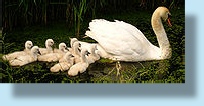
Winter is the time for the migrant thrushes, redwings and fieldfares, but other winter migrants such as waxwings, bramblings and siskins may also be encountered. Summer too has its migrants. Swallows and house martins feed over the canal and sand martins may be seen in passage. The monotonous song of the reed warbler is a constant presence during the summer, though it is less commonly seen, and its cousin, the sedge warbler is present in thick canal side vegetation, particularly around Coney Meadow. White throats sing from the hawthorn bushes and grasshopper warblers can be heard in the rough vegetation in the wetter areas such as Coney Meadow. Water fowl, apart from mallard ducks and swans, are not well represented but there have been records of teal in Coney Meadow and tufted ducks on the canal near Hawford.
Occasional real rarities (for the area) turn up and are worth looking for. There are records of hen harrier, hoopoe, red kite, hawfinch and hobby and others must be around.
Mammals
Most British mammals, except for rabbits are rarely seen, being small and hidden in vegetation or nocturnal. Nonetheless, the list for the Salwarpe Valley, along the canal, is: rabbit, fox, badger, mink, otter, pipistrelle bat, long-
Insects and other invertebrates
It is impossible to do justice to the huge variety of insects and other invertebrates to be found along the canal corridor so only those most easily and commonly seen will be mentioned.
Along any waterway the dragonflies and damselflies must feature. We do not have a long list of these insects but from late spring to early autumn some will always be seen. The list of larger dragonflies includes black-
Butterflies too will be present for most of the year from spring to autumn. Even in winter the occasional red admiral may be tempted from hibernation on warm days. The records include large white, small white, green-
A few bees and wasps are large and brightly coloured so as to come to general attention but many more, such as the beautiful grey and black Andrena cineraria, which nests in a few places near the tow path, are unlikely to be noticed. Most prominent are the bumblebees. The common species being seen regularly are red tailed, white tailed, buff tailed, common carder bee, early bumblebee, garden bumblebee and tree bumblebee (a relatively recent addition to the British list) plus the parasitic vestal cuckoo-
Snails seem to like climbing tall plants, particularly hogweed and hemlock, and the common striped black lipped snails will be found in large numbers as will a brown snail shading to dark brown near the lip. The brown snail is the Kentish snail which used to be thought more typical of limestone country.
Geoff Trevis
What you can find on the Droitwich canals by Geoff Trevis
This Month’s Nature Trail -
March is the month when it all starts to happen. Look out for all the spring flowers and shrubs coming into bloom and, if you are interested in bees and other invertebrates, a close look at Pussy Willow is worth the effort. The flowers are rich in nectar and provide the initial energy source for many species as they emerge from hibernation. For example, large queen bumblebees are likely to command attention and early butterflies such as Red Admiral and Comma will take flight on warm days. March is also the month when the winter migrant birds will have left and the summer ones will be arriving. Chiff-
Geoff Trevis